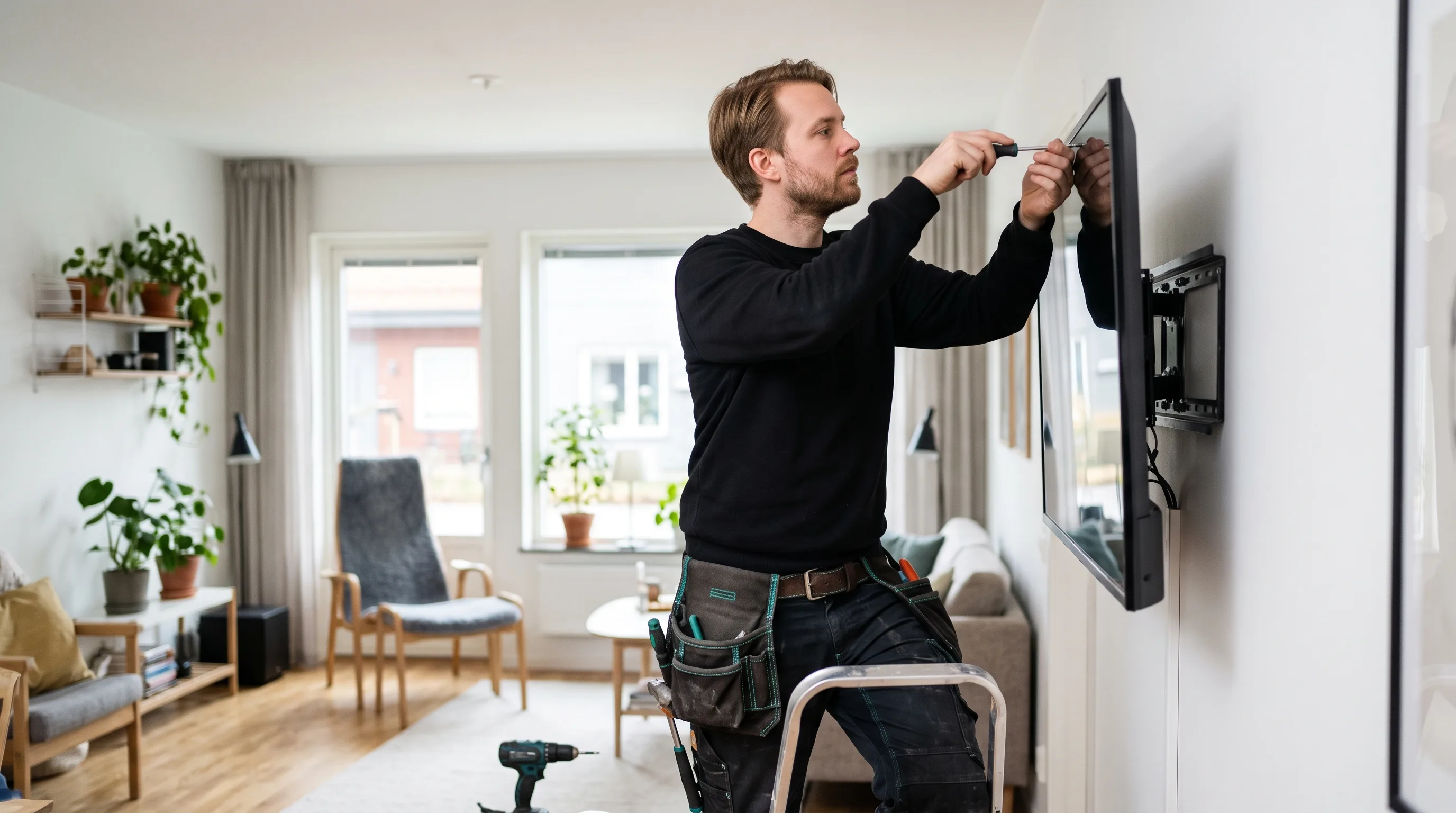
Mounting a TV on the wall means a Runner puts up a wall bracket suited to your wall (concrete, brick or plasterboard), mounts the TV securely, and, if needed, routes the cables neatly through a cable channel. Perfect if you want a clean, secure installation with no visible wires.
Here are answers to the most common questions before you book.
What height should the TV be mounted at?
Placement matters almost as much as the mounting itself. Check the distance to the sofa so you get the right viewing angle, and test the height while sitting down before you decide. 60 centimetres up from the floor is standard, but the main rule is that you should look straight at the middle of the TV when sitting comfortably. Also make sure that light from windows or lamps won't cause glare where the TV is going to sit. Measure carefully, and use a spirit level for the best result.
Which wall bracket should I choose?
There are several types to choose between, and the choice affects both how the TV sits and what the wall can handle. Always check the VESA measurement before you buy — it's the standard for the hole spacing on the back of your TV and is listed in the TV's manual. Also choose a bracket with a weight capacity above your TV's weight, not right at the limit. If you're unsure which bracket suits your particular TV, ask staff in store or check the manufacturer's recommendations. Fixed wall bracket: the most common type and also the most robust and affordable — the TV sits close to the wall, which many think looks best, and it suits most wall types. Tilting-and-swivel bracket: good if you want to watch the TV from several places in the room, requires a more secure mounting, and is less suitable on plain plasterboard or for heavier TVs, where the bracket should instead be screwed into the studs behind the plasterboard. Tilting wall bracket: lets you adjust the TV's angle for the best viewing position, sticks out a little more than a fixed bracket but less than a swivel one. Full-motion wall bracket: combines tilt and swivel, and some models can also be adjusted in height — gives the most flexibility but sticks out the most and usually needs a sturdier wall.
Can my wall handle a TV mount?
It depends entirely on the wall type. A heavier TV shouldn't be mounted directly on plain plasterboard, and a swivel bracket needs a more secure mounting than every wall can handle. Before drilling, it's also important to check what's inside the wall. A multi-detector helps you find pipes, wiring and studs, so you know exactly where you can and can't drill.
How does mounting a TV work on different wall types?
It differs quite a bit depending on what the wall is made of. On panelling or chipboard it's usually straightforward to mount the TV, even a heavier model. On plasterboard the bracket should be fixed into the studs behind the boards, with screws suited for wood and ideally plasterboard anchors or expanders for extra support. That's especially important if the TV is heavy or the bracket is a swivel type. On a concrete wall you need to drill and plug the holes before screwing the bracket in place, using the right drill (impact drill or hammer drill), plug and screw. A tip is to make a small mark with a centre punch before drilling so the drill bit doesn't slip. On a brick wall an impact drill is used together with a universal plug. Feel unsure about assessing it yourself? That's exactly the kind of job our Runners do every day, safely and securely regardless of wall type.
How do you hide the cables after mounting a TV?
There are two common solutions. A self-adhesive cable channel goes up quickly under the TV and can be bought from most electronics retailers. If you want a completely invisible solution, the cables can be routed inside the wall. That takes a bit more work and is harder on a concrete or brick wall, but works well on plasterboard or chipboard, where there's often an air gap behind. You then drill one hole behind the TV and another just above, for example near a TV bench, and run the cable between the two holes.
What does it cost to get help mounting a TV on the wall?
The price averages around 800 kr after the RUT deduction, with a range between 550 and 1500 kr depending on the job. What affects the price most is how big the TV is (a TV over 50 inches usually needs two people), plus the type of wall bracket and what kind of wall you have.
What tools are needed to mount a TV?
Usually a drill, spirit level, laser measure, screwdriver and a stud finder to locate the studs behind the wall are enough. Which type of drill bit and plug you need depends on the wall type. Concrete and brick, for example, need different tools than plasterboard or chipboard.
What do I need to prepare before mounting the TV?
Make sure you have the right tools and materials ready before you start, for example a screwdriver, wall bracket, wall screws and wall plugs suited to your wall type. Also check that the wall is suitable for mounting and that there's a power outlet near where the TV will sit, otherwise the cables may end up visible or too short.
We use cookies to improve your browsing experience, to show personalised ads or content, and to analyse our traffic. By clicking "Accept all" you consent to our use of cookies. Read more in our cookie policy.
Necessary
Required for the site to work. Cannot be turned off.
Analytics
Helps us understand how the site is used, e.g. Google Analytics.